The Characters of the Nativity Scene
In the nativity scene, nothing is left to chance. Each figure has a name, a specific place, and even a day when it enters the scene. Behind the apparent freedom of the arrangement lies an ancient set of rules: learning them means understanding why Mary stands on the right, why the Magi arrive late, and why the village is full of people who aren’t even looking at the manger.
The nativity scene appears to be a free-form arrangement, yet it is actually a text: a three-dimensional narrative, written and rewritten over eight centuries, in which each character is a word and each position a rule of syntax. It is not built—it is composed.
A theater founded in Greccio
The first time was in Greccio, in 1223. St. Francis wanted to “see with his own eyes” the Nativity in Bethlehem and staged a live Nativity scene, complete with the manger, the ox, and the donkey. That gesture gave rise to a tradition that has become codified over the centuries: from medieval wooden figurines to the great Neapolitan workshops of the 18th century, each era has added figures, poses, and meanings. When we arrange the figurines today, we follow—often without realizing it—those very same rules.
The Grammar of Positions, Figure by Figure
The main figures occupy specific positions around the manger. These are not arbitrary conventions: each one conveys a meaning through its placement.
- The Baby Jesus — at the very center, in the manger. It is celebrated only at midnight on December 24: it is God becoming man in the humblest of circumstances.
- Mary — to the right of the Child (from the viewer’s perspective). She is dressed in blue and wears a red cloak, kneeling in adoration: the place of honor belongs to her.
- Joseph—to the left of the Child, standing slightly behind Mary. He is dressed in yellow or brown, carrying a staff and a lantern: an earthly guardian, standing one step back to make way for the mystery.
- An angel—up above, in the upper right corner, suspended as if he were about to land, his wings spread wide. He is the voice that brings the announcement.
- The ox and the donkey—behind the manger, on either side of the Child. They do not appear in the canonical Gospels, but have been depicted since the fourth century based on an interpretation of Isaiah’s prophecy: they warm the infant God with their breath.
- Shepherds — approaching from the left. They arrive on the night of December 25, called by the angel: they are the first, the humble, the unexpected witnesses.
- The Three Wise Men — they arrive on January 6. On December 25, they stand a short distance from the stable, and every day they move a few steps closer, on their way to the Nativity.
The Nativity Scene Calendar: Who Appears and When
The Nativity scene is not a static image: it is a scene that unfolds over time, following the liturgical narrative. Here is the sequence of events.
| Moment | Who Enters the Scene |
|---|---|
| During Advent | The landscape, the stable, the shepherds still in the mountains |
| December 24, midnight | Baby Jesus, laid in the manger |
| December 25 | The shepherds arrive at the stable |
| Starting December 25 | The Three Wise Men, traveling from afar |
| January 6, Epiphany | The Three Wise Men arrive at the Nativity scene |
The Magi, who take one step forward each day, are perhaps the most beautiful image in the entire tradition: the Nativity scene does not depict a single moment, but a journey that unfolds right before our eyes at home.
The Village and Its Trades
There is a part of the nativity scene that isn’t facing the manger. In the Neapolitan tradition, an entire village gathers around the Holy Family: the washerwoman at the washhouse, the innkeeper on his doorstep, the knife-grinder, the fisherman, the old man lying down to rest beside his donkey along the Road to the East. They are not mere extras. They are the very essence of the Neapolitan nativity scene—the sacred does not take place in a separate space, but in the midst of life: in the trades, in the alleys, at the resting spots of travelers. This is why the Neapolitan style features hundreds of different figures.
The Arabic style, on the other hand, takes a different approach: it transports the scene back to first-century Palestine, with biblical costumes and settings. More subdued and more historical, it is particularly widespread in Spain, Malta, and, in Italy, Sicily. Two interpretations of the same night—one that brings it into our homes, the other that takes us to Bethlehem.
The hand that gives the characters their faces
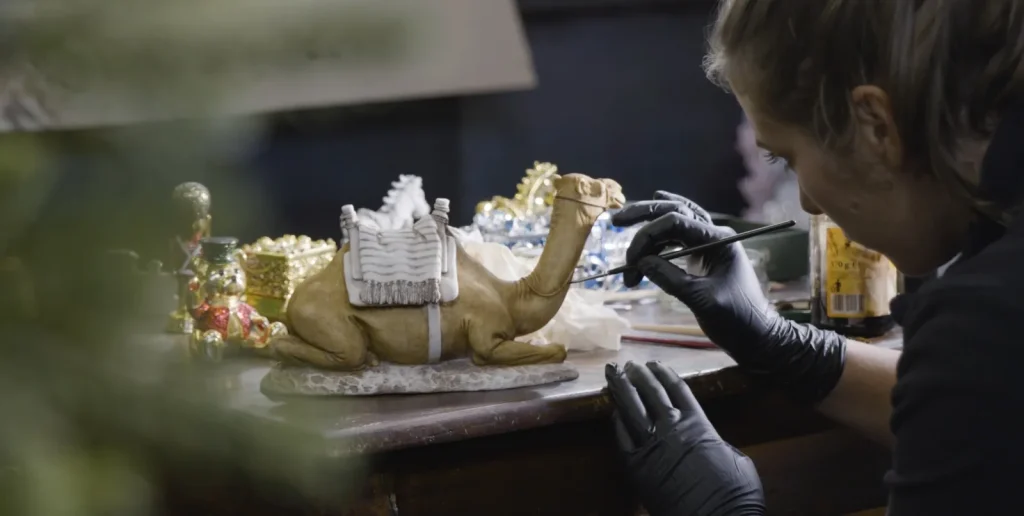
For a figure to “look right,” it’s not enough to follow the rules—it needs to be well-sculpted. Landi figurines are crafted by Martino Landi, a sculptor born in Lucca in 1957 and trained at the Academy of Fine Arts in Florence. That classical training is evident in the proportions, the anatomy, and the rendering of the faces—in the way a shepherd truly looks his age. Each piece begins as a wax sculpture: it is there that the sculptor defines every fold and every expression, before casting it in PVC or marmorese.
This is not a minor detail. Landi’s works are recognized by the Ministry of Cultural Heritage and Activities as works of artistic value, and the 20-cm PRESTIGE 20 line was blessed by John Paul II during the Jubilee of 2000. In the premium lines, each figurine is hand-painted, and no two are identical. Landi Moranduzzo figurines cover all characters—sacred protagonists and village figures—in fourteen scales, ranging from 3.5 cm to 30 cm: there’s a size for a nativity scene on a piece of furniture and one for one that fills a room. To ensure the correct proportions between the figures and the stable, consult the size guide.
Give each figure in your Nativity scene a face, in the right scale for your home.