Neapolitan Nativity Scene: History
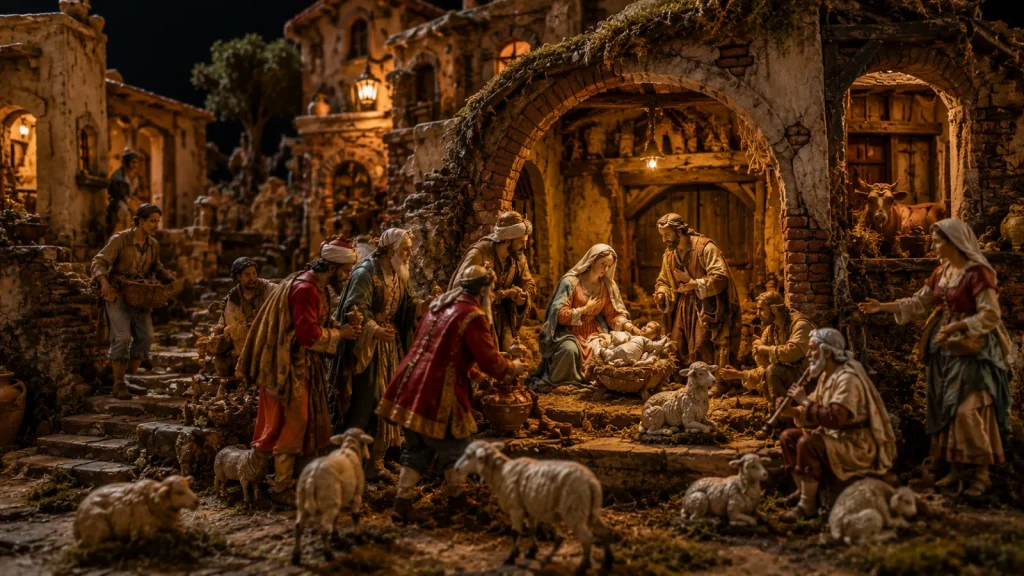
The Neapolitan nativity scene is not just a depiction of the Nativity: it is an entire city in miniature. Originating as a court art form in 18th-century Naples, it places the birth of Christ at the heart of everyday life—among taverns, shops, and markets—and entrusts the story to dozens of characters who seem to have nothing to do with the manger. Yet they are precisely what lies at the heart of its charm.
Anyone seeing a Neapolitan nativity scene for the first time is taken aback: where is the Holy Family amid all that swarm of people? That’s the point. In Naples, the sacred does not take place in a secluded spot, but right in the midst of the world—amid the clamor of the market, the smells of the tavern, and the social hierarchies of a vibrant city. To understand this, we must go back to a narrow street in the historic center and the obsession of a king.
San Gregorio Armeno: The Shepherds’ Way

In the heart of Spaccanapoli, a narrow street just over two hundred meters long has been home to the global epicenter of the nativity scene tradition for centuries. Via San Gregorio Armeno —“the street of the shepherds”—is an unbroken row of workshops run by master nativity scene makers, open not only in December but all year round. Here, the nativity scene is not just a seasonal decoration: it’s a daily craft.
The road’s history dates back to ancient times. According to tradition, a temple dedicated to Ceres once stood right at this spot, where the faithful offered small votive terracotta figurines: an art of sculpting figures that Christianity would later inherit and transform. As early as the Middle Ages, the monasteries in the area were selling sacred terracotta images, and since then, the town has never stopped shaping clay. The “pastorari” —as the artisans are called—pass down their workshops and techniques from father to son, often for generations.
The Bourbon Eighteenth Century: When the Nativity Scene Became Court Art
The grand Neapolitan nativity scene originated as a form of court art. Charles of Bourbon, King of Naples from 1734, had a passion for nativity scenes that bordered on obsession: it is said that he set them up himself, while Queen Maria Amalia of Saxony sewed the figures’ costumes. From the court, the trend spread among the nobility, and a competition soon ensued: every noble family wanted the most lavish, most populous, and most spectacular nativity scene.
The figurines from that period are true masterpieces of craftsmanship. The body is a wire-and-twine mannequin—jointed, so that each figure can be posed—while the head, hands, and feet are made of painted terracotta, with glass eyes set in them just like those of a doll. The clothes are made of real silk and velvet, sewn to scale; the vendors carry baskets full of food items, each one meticulously reproduced. Leading sculptors, such as Giuseppe Sanmartino, the creator of the famous Veiled Christ, were also commissioned to model the heads.
This season’s highlight can still be admired: the Cuciniello Nativity Scene, on display at the National Museum of San Martino in Naples, features hundreds of 18th-century figures and remains the benchmark for understanding what a Neapolitan Nativity scene truly is. With the Bourbons, the Nativity scene moved out of the church and into the palace—and, shortly thereafter, into everyone’s homes.
Anatomy of the Scene: The Rock, the Tavern, the Market
The Neapolitan nativity scene is not a painting; it is a living landscape. Every element has its place and, almost always, a meaning that goes beyond mere decoration. Here is the grammar of the scene.
| Element | What it represents |
|---|---|
| The Rock | The rocky outcrop that supports it all: one can often glimpse the ruins of classical temples there—the pagan world crumbling before the birth of Christ. |
| The Tavern | The place of rejection: it is the inn that had no room for Mary and Joseph. Noisy, lavishly set, indifferent to the mystery unfolding right next door. |
| The Market | There are traditionally twelve vendors, one for each month of the year: human time flowing around eternity. |
| The Well | In popular tradition, it is a threshold between the world of the living and that of the dead: on Christmas Eve, no one draws water from it. |
The Secular Characters: A World Around the Manger

This is where the Neapolitan nativity scene stands out from all the others. Alongside the sacred figures, a crowd of characters drawn from everyday life gathers, each with a name and, often, a hidden meaning. The most famous is Benino, the shepherd asleep on a hillside: according to legend, the entire nativity scene is his dream, and woe betide anyone who wakes him, for everything would vanish. Then there is the Shepherdess in traditional dress, the Blind Man with the rooster, the Washerwoman, the Fisherman, and the Innkeeper.
Many figures represent pairs of symbols. The two friends sitting in the tavern, Zi’ Vicienzo and Zi’ Pascale, traditionally embody Carnival and Death; the gypsy woman who reads palms foretells, with her crystals, the Child’s future Passion. Nothing in the Neapolitan nativity scene is placed there by chance: it is a theater in which every character plays a part.
And it’s a tradition that’s still alive today. Every year, in the shops of San Gregorio Armeno, master craftsmen sculpt figurines of current public figures—politicians, soccer players, and television personalities. This is not a modern deviation: it is precisely the original spirit of the Neapolitan nativity scene, which has always placed the news of its time around the manger.
Good to know
Benino, the sleeping shepherd boy, is the key to understanding the entire nativity scene: tradition holds that the Nativity, the market, and the tavern are all part of his dream. For this reason, as a superstition, many nativity scene builders recommend never “waking him up”—that is, never moving him from his sleeping position.
In Naples, the birth of Christ does not take place in a place separate from the world, but within the world: amid the market stalls and the clamor of the tavern. This is perhaps its sweetest heresy.
From terracotta to resin: the Landi tradition

The Neapolitan tradition has inspired all Italian Nativity figurines: the idea that a figurine is not a mass-produced object, but a character with a face, an age, and a personality. The Landi Moranduzzo line embraces this legacy and brings it to life in a modern material—marble resin—without losing the attention to facial expression and the depth of the gaze that distinguishes a handcrafted figure from an industrial product.
Each figure begins as a hand-modeled wax sculpture, just as the masters of old used to work with clay; the premium lines are then painted one by one, so that no two pieces are exactly alike. It bridges the gap between the 18th-century workshop on San Gregorio Armeno and the nativity scene you can now set up in your own home. Read the story of the Landi family.
Landi Figurines
Create Your Own Nativity Scene with Landi Figurines
The Italian Nativity scene tradition, crafted from hand-painted marble-effect resin. Sacred figures and village characters, available in a variety of sizes.
Frequently Asked Questions About the Neapolitan Nativity Scene
What is a Neapolitan nativity scene?
Why is Via San Gregorio Armeno famous for its nativity scenes?
Who is Benino in the Neapolitan nativity scene?
Why are there modern figures in the Neapolitan nativity scene?
What is the difference between a Neapolitan nativity scene and a traditional nativity scene?
From the workshop on San Gregorio Armeno to today’s hand-painted resin: the materials may change, but the care taken with each character’s face remains the same.
Moranduzzo — Landi Line — Florence