Christmas Elves: The Story
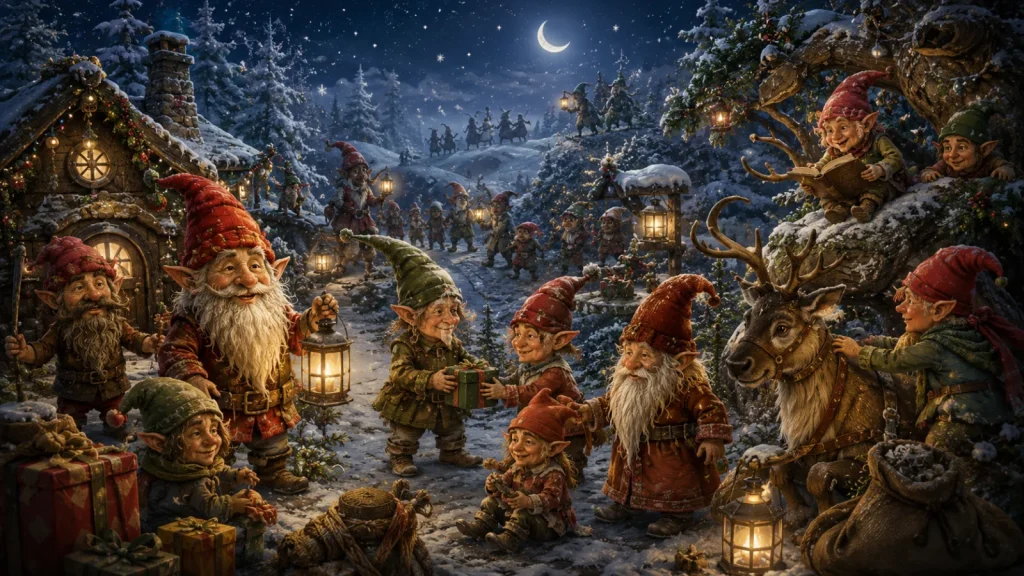
In the Christmas imagination, “folletto” and “elf” are often used as synonyms. They are not. The cheerful, orderly elves in Santa’s workshops are a recent, tamed version of much older and more ambiguous creatures: the household spirits of European folklore. And Italy has one all its own—a mischievous Tuscan spirit—the Buffardello.
Before they became the smiling, pointy-eared creatures we know today, elves were small spirits of the home and the countryside: helpful if respected, capable of real mischief if forgotten. Exploring their origins is also a way to understand how a tradition changes as it travels from one culture to another. Let’s take a look.
The Tomte, the Spirit of the Farm (Scandinavia)
In the Nordic countries, the main character is the Tomte (in Sweden) or Nisse (in Denmark and Norway): the guardian spirit of the farm. He is a few dozen centimeters tall, wears a pointed red hat, and is hardworking but easily offended. If the family treats him with respect, he watches over the house and the animals all year long; but if he’s neglected—and especially if they forget to leave him his bowl of porridge with butter on Christmas Eve—he becomes vengeful: he makes the animals sick, hides the tools, and causes trouble. The over-the-top cheerfulness of the commercial elf is completely foreign to him.
The Thirteen Elves of Iceland
In Iceland, there are as many as thirteen Christmas elves: the Jólasveinar, the “Christmas men,” who come down from the mountains one by one starting on December 12 and leave, one by one, after Christmas. Each has a name that says it all and a specific mischievous habit: Stúfur (Cigarette Butt) steals frying pans to lick the leftovers, Þvörusleikir licks the ladles, and Hurðaskellir slams doors at night to wake everyone up.
Originally, they were frightening figures, the children of the ogress Grýla, who, according to legend, kidnapped disobedient children. In the 20th century, they became more benign: today, Icelandic children place a shoe on the windowsill, and every night they find a treat inside if they’ve been good—or a rotten potato if they’ve been naughty.
Italian Elves: Every Country Has Its Own
Italy, too, is full of goblins, each with a different name in almost every region: the Monachicchio in Basilicata, the Mazapégul in Romagna, the Mazaròl in Veneto, and the Munaciello in Naples. They’re almost all small, quick, and mischievous: they tangle the hair of those who are sleeping, move objects around, and trigger strange dreams. They aren’t entirely evil, but they aren’t exactly cooperative either—they follow a logic all their own. And then there’s the one that concerns us most closely.
The Buffardello, the Tuscan goblin

The Buffardello is a goblin from Tuscan folklore, found primarily in Garfagnana, the Lucca area, and Versilia. Its name likely comes from the verb “buffare,” meaning “to blow”: it is a creature linked to the wind, appearing with one gust and disappearing with another. It lives among the branches of oaks, chestnut trees, and fig trees, and at night it enters homes and barns.
His pranks are always the same, passed down from generation to generation: he tangles horses’ manes and the hair of those who are sleeping (those who wake up with their hair in knots, the old folks used to say, have had a visit from the Buffardello), hides objects, knocks pots and pans off the stove, and sometimes sits on the chest of those who are resting, bringing them heavy dreams. In the Lucca area, this figure even has a cousin with a name of his own, the Linchetto, who specializes precisely in pranks played on those in that half-asleep state. The Buffardello, however, isn’t mean: he’s unpredictable, a bit of a joker, and a bit jealous of the home he’s chosen.
What does all this have to do with us? Well, the Buffardello originates just a few valleys away from where Moranduzzo crafts the spirit of Christmas. In fact, it comes from the same mountains as the Landi line, created by a sculptor from Lucca. Florence, Lucca, the Garfagnana: our little elf is closer than you might think.
Good to know
Like many European goblins, the Buffardello also wears a little red hat that he cherishes dearly. Legend has it that if someone manages to steal it from him, the goblin is willing to reveal a hidden treasure just to get it back—provided they’re quick enough not to be tricked in return.
Christmas Elves in Europe: At a Glance
| Goblin | Where | Character |
|---|---|---|
| Tomte / Nisse | Scandinavia | Guardian of the farm, easily offended: he wants his porridge |
| Jólasveinar | Iceland | Thirteen, one a day starting in December; each one a little prank |
| Buffardello | Tuscany (Garfagnana, Lucca region) | Bound to the wind; ties up hair and manes, plays nighttime pranks |
| Munaciello / Monachicchio | Naples, Basilicata | Small, fast, mischievous, and unpredictable |
Elves have never been just good or just bad: they’re the way our grandparents gave a face to the wind, the creaks of the house, and the little mysteries of every winter night.
Goblin or gnome? They’re not the same thing

The Christmas gnome that floods the markets starting in November—with a very long white beard, a red or gray hat, a chubby body, and no eyes—is the modern and reassuring version of the Scandinavian Tomte, made appealing for the global market. He is a tamed descendant of those ancient spirits: he has lost their ambivalent nature but has retained their tenderness.
The real elf—the one from folklore—is something else entirely: he has a personality, a logic of his own, and sometimes a mischievous streak. Perhaps that’s why, of all the creatures of Christmas, he remains the most fascinating—because he never lets himself be completely tamed. And Buffardello, stubborn as he is, is the least likely of all.
Decorations and Ornaments
Let the little spirits of Christmas into your home
Gnomes, elves, and a thousand decorations from Italy’s first Christmas decoration factory: the magic of the holidays, crafted with Florentine care.
Frequently Asked Questions About Christmas Elves
What is a Christmas elf?
What is the Buffardello?
How many Christmas elves are there in Iceland?
What’s the difference between an elf and a Christmas gnome?
Why are there gnomes at Christmas?
Tomte, gnomes, the thirteen little men of Iceland, and our very own Buffardello: every Christmas brings with it a little band of mischievous spirits. All it takes is a twig out of place, or a knot in your hair when you wake up, to suspect that they’re still here.
Moranduzzo — Christmas Since 1946 — Florence